Every automation leader eventually reaches the conversation that decides the next phase of investment.
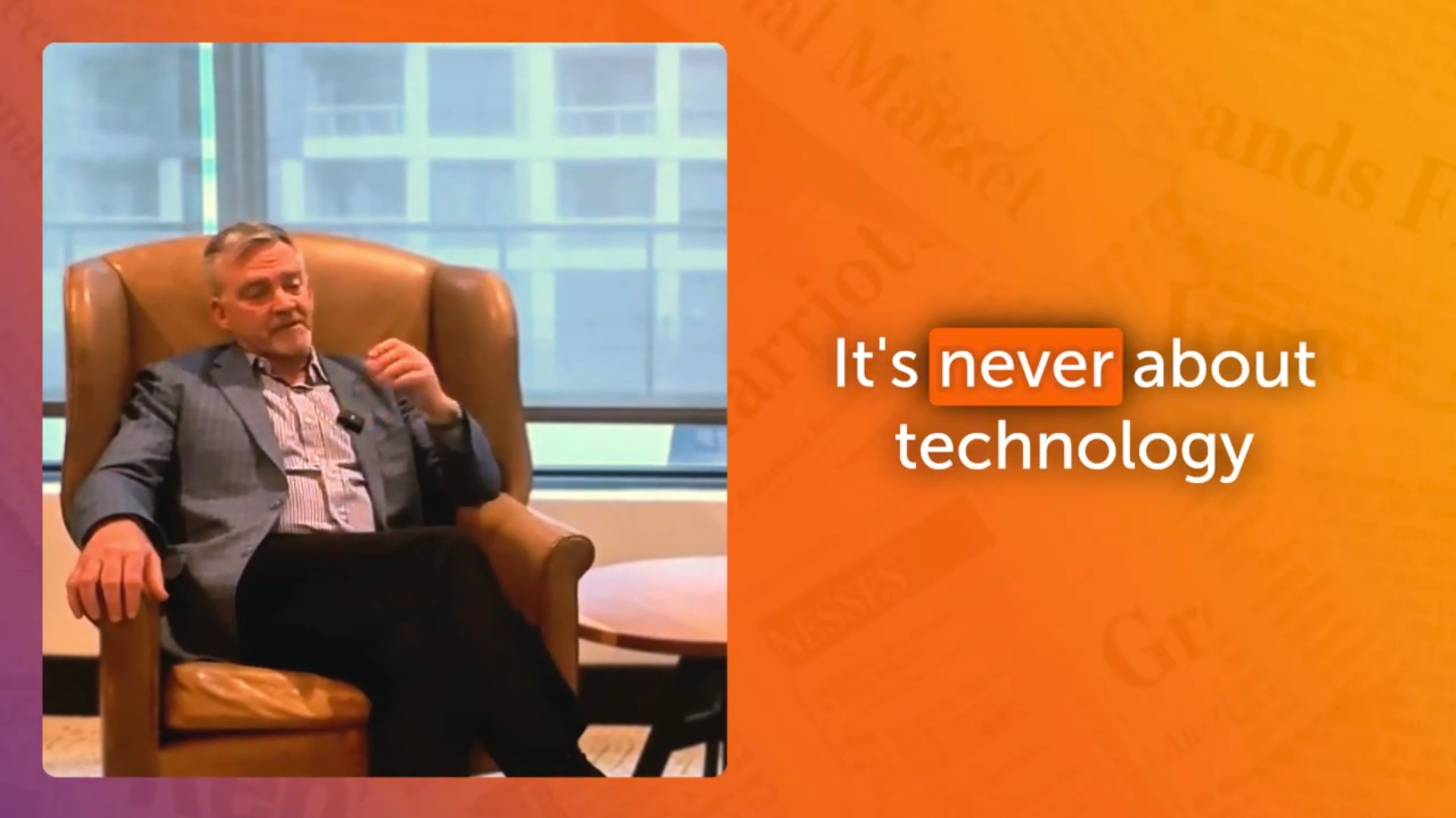
Feature counts and platform details rarely move a room full of executives who think in P&L, retention, and market position. In this episode of the Agentic Edge podcast, host Micah Smith sits down with Geoff Cronin, Strategic Advisor to Tangentia, whose career spans CEO of Capgemini Canada, building out Grant Thornton's advisory practice, and — most recently, leading a full application replatforming as CIO of the Liquor Control Board of Ontario. Geoff retired from that role in January and now spends his time advising organizations on growth and technology transformation, drawing on decades of sitting on both sides of the executive table.
AI is a catalyst, not the starting point
AI has quietly powered enterprise systems for years, route optimization, personalization, algorithms running under the hood of everyday operations. What's changed with generative and agentic AI is how visible it's become, and the pressure that visibility creates.
That pressure is the problem. Many organizations now feel they have to do something with AI, and that urgency crowds out the harder questions: What actually needs to change? Why does it matter? Who benefits?
Take a step back before taking a step forward. Agentic AI opens real opportunity — but the organizations that capture it start with a clear business objective and design the technology to serve it, not the other way around.
Rethink the process before you automate it
One of Geoff's sharper points: agentic AI shouldn't be pointed at existing processes as-is. Most organizations carry redundancy, workarounds, and historical constraints baked into how they operate, automate that, and you've preserved the dysfunction while adding a technology bill on top of it.
The harder, more valuable path is to redesign the process first, then apply the technology to the new version. Geoff calls this being willing to "break some glass." It also forces an honest conversation about the workforce, because redesigning process changes what work looks like and who does it. His advice to leadership teams is blunt: if the CEO and board aren't willing to acknowledge the workforce will change, don't start the initiative at all. The payoff from agentic AI depends on rethinking the work, not just installing new tools around the old one.
Speak the language of the business
The most common mistake automation leaders make when pitching executives is leading with the wrong vocabulary. Automation counts, agent architectures, and platform capabilities matter internally — but they rarely land in the C-suite.
Geoff describes the kind of CIO every CIO now needs to become: one fluent in business strategy, P&L, customer retention, and market position, where technology shows up as the enabler of those outcomes rather than the subject of the conversation. His advice extends to anyone building a business case — educate leadership on where the organization is headed, show what competitors are doing well and where they're falling short, and connect the program to that vision before bringing the technology in as the mechanism to deliver it.
The best sellers understand the customer's challenges before they pitch. Internal pitches work the same way, understand what the executive team is trying to achieve, then show how your program gets them there.
Shadow IT is a signal, not just a risk
Shadow IT has been a governance concern for years, but LLMs have raised the stakes — employees with curiosity and basic problem-solving skills can now build scripts, tools, and workflows that would have required a developer a year ago.
Geoff's read: shadow IT shows up when the official technology function isn't delivering value fast enough. The business finds a way to solve its own problems, with or without IT, and when IT can't keep pace, the workarounds multiply. The fix isn't to lock it down — it's to deliver faster and bring that innovation inside the tent, pairing citizen development with real governance: check-ins, code review, and visibility, so creative problem-solving and oversight can coexist.
Every organization is an IT organization now
IT used to operate in a silo, specialized terminology, a seat outside the core business conversation. Geoff argues that era is over. Every organization is an information-technology organization, every organization is a data organization, and every executive has a stake in both. A division leader not running their function on transformative platforms isn't doing the job.
That convergence changes how governance works: speed-to-value becomes a shared responsibility across the executive team, risk registers expand to cover AI and automation exposure, and transformation decisions get owned collectively rather than parked with IT. The organizations that operate this way move faster. The ones still working in silos will find themselves behind.
Future is Autonomous
Watch the full episode
Geoff Cronin and Micah Smith go deeper on each of these ideas in the full conversation, recorded in person for the Agentic Edge podcast.
Tangentia works with enterprise leaders to translate automation ambition into a business case that holds up in the room, then builds the agents to back it up.